May 2026 saw an uptick in high-impact vulnerabilities, notably within Ghost CMS, affecting 20 vendors and prompting urgent remediation efforts.

In May 2026, the Insikt Group identified a total of 41 high-risk vulnerabilities that require immediate attention, marking an 11% increase from April. Each of these vulnerabilities carries a Very Critical Recorded Future Risk Score, underscoring their potential threat to cybersecurity. As organizations continue to digitalize and shift more of their operations online, the repercussions of these vulnerabilities are alarmingly significant.
The vulnerabilities span products from 20 different vendors, with Vercel products accounting for approximately 27% of the total vulnerabilities. This high percentage stems from increased activity around Next.js, as evidenced by honeypot data. The remaining vulnerabilities are dispersed across various sectors, including enterprise software, security infrastructure, developer tools, and cloud services. With many businesses pivoting towards agile methodologies, the pressure to develop and deploy rapidly often leads to overlooked security measures—resulting in a higher incidence of vulnerabilities across such platforms.
May 2026 Vulnerability Overview
The following table outlines the 22 vulnerabilities that were actively exploited throughout the month. Importantly, it does not reflect the 19 CVEs identified through honeypot activity, which are accessible to Recorded Future customers via the CVE Monthly Report.
Score
Table 1: Active vulnerabilities recorded in May 2026, excluding honeypot-sourced CVEs.
Emerging Threat Patterns
- Ghost CMS emerged as a critical target, exploited in large-scale ClickFix and FakeCaptcha poisoning operations by cybercriminals. Attackers have leveraged these operations not just to breach systems but to manipulate user data in a way that can have cascading effects across trusted networks.
- 12 vulnerabilities enabled remote code execution (RCE), affecting eight vendor products, including well-known names like Microsoft and Adobe. These exploits raise serious concerns about the ability of organizations to protect their systems from external threats, especially when popular products are involved.
- Public proof-of-concept (PoC) exploits have been identified for 32 of the recorded vulnerabilities, indicating a high level of availability for attackers. The burgeoning community around exploit development makes it easy for malicious actors to gain access to tools that can put vast numbers of systems at risk.
- The prevalent flaws included cross-site scripting and SQL injection, highlighting persistent vulnerabilities in widely used applications. The maintenance or patching of software often takes a backseat while innovations roll out, resulting in a population of applications that are rich with unaddressed weaknesses.
- Alarmingly, five vulnerabilities have been publicly known for 15 years or longer, illustrating attackers' continued exploitation of dated weaknesses. This raises important questions about how security practices evolve—or fail to—in response to long-standing issues.
Diving Deeper: Exploitation Insights
This section underscores the actively exploited vulnerabilities, particularly those associated with documented attack campaigns or for which public PoCs exist. Those lacking significant public technical detail are summarized in the quick reference table provided earlier. It’s a stark reminder: without thorough understanding and oversight, companies leave themselves vulnerable to attacks.
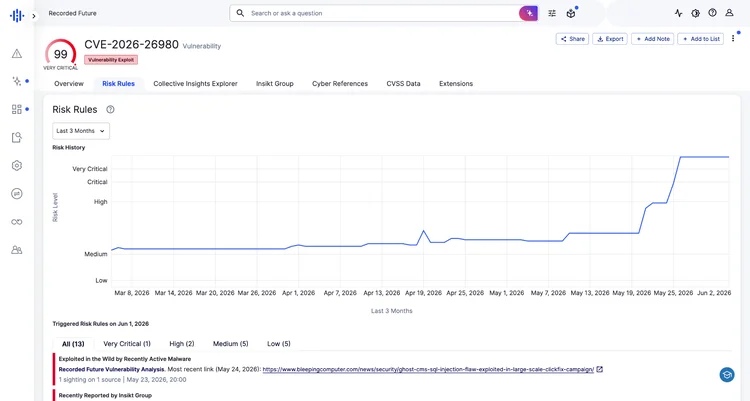
Case Study: CVE-2026-26980 Exploit in Ghost CMS
On May 21, 2026, XLab detailed significant ClickFix poisoning attacks targeting vulnerable Ghost CMS setups through CVE-2026-26980. This critical SQL injection vulnerability allows attackers to gain unauthorized access to Ghost Admin API keys, leading to unauthorized content alterations. And this is the part most people overlook: the implications of such access can cascade into a crisis of trust for any affected organization.
Threat actors exploited more than 700 compromised Ghost CMS websites, delivering malicious social engineering tactics that duped victims into unintentionally running malware. This trend isn't surprising; social engineering remains one of the most successful methods for breaching defenses, relying on human factors that are notoriously hard to guard against.
The malicious payload, named UtilifySetup.exe, although it underwent static and dynamic analysis, showcased capabilities such as DLL injection and system enumeration, which indicates its sophistication and intent. With an ability to inject code and gather system-level data, this malware exemplifies the dangers lurking behind unpatched vulnerabilities.
- The payload is designed to retrieve critical system information and execute code upon system startup, further entrenching its foothold on a targeted machine. Such tactics highlight the relentless nature of modern cyber threats, which can lay dormant but still pose immense risks.
Further technical intelligence on this activity, including comprehensive exploit methodologies and indicators of compromise, is available to Recorded Future customers for a deeper understanding of the ongoing threat landscape. What this means for you: organizations must prioritize threat intelligence, ensuring they stay one step ahead of evolving cyber risks.
Future Implications and Significance
The sharp rise in vulnerabilities signals an urgent need for organizations to reassess their cybersecurity frameworks. If you're working in this space, it's time to rethink how risk is managed. Focusing solely on quick deployments without sufficient security measures isn't just shortsighted; it's inviting disaster.
As cybersecurity threats become increasingly tailored and sophisticated, the risks associated with outdated vulnerabilities cannot be overstated. Organizations must prioritize updates and proactive risk management. Ongoing education around best security practices is essential; training employees on how to recognize social engineering attempts can significantly mitigate attack vectors.
Investments in threat intelligence solutions will also be key. Not only do they provide insights into vulnerabilities, but they also keep organizations informed about their specific risk profiles and help guide patch management strategies. The stakes are high, and ignoring evolving threats is not an option. Everyone has something to protect—don't wait until an incident forces your hand.



Discussion
Sign in to join the discussion.