DeepSeek-V4.1-Flash enhances AI efficiency by optimizing processing and memory for long-context tasks, reducing costs while improving performance.
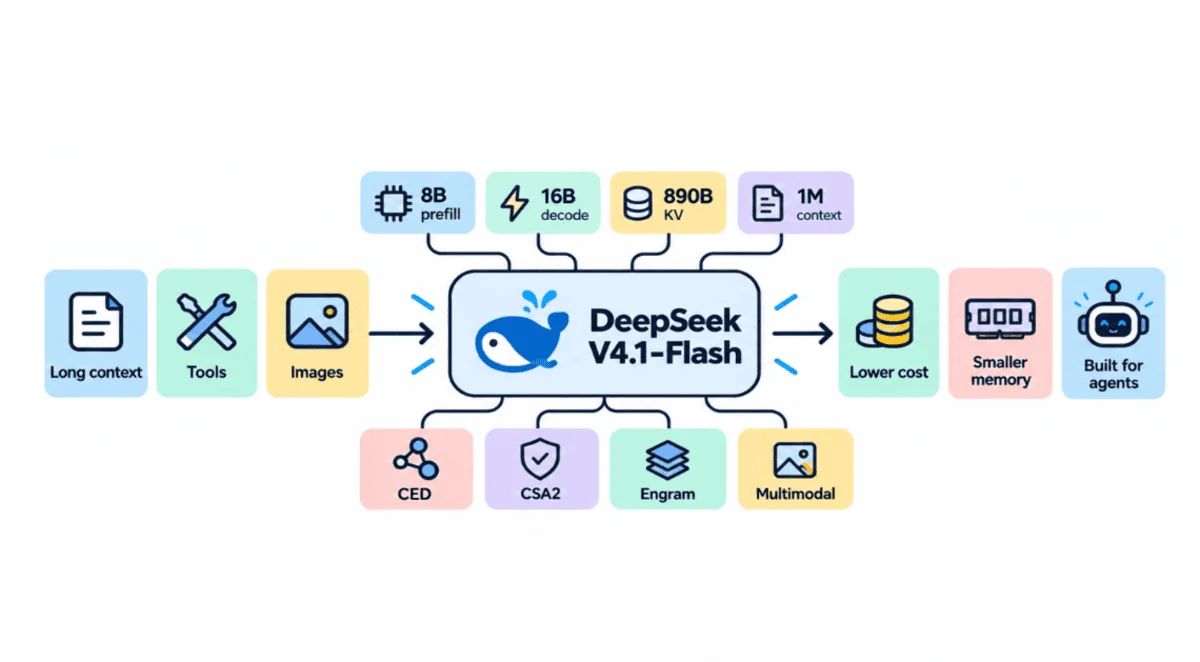
DeepSeek's latest release, **DeepSeek-V4.1-Flash**, isn't just notable for its benchmark scores—though they are undeniably impressive. The real story lies in its architectural redesign, which tackles some of the biggest challenges facing AI as it shifts towards being used as long-running agents.
### A New Direction in Architecture
DeepSeek isn’t just scaling up its models; it's redefining how the components work together to enhance efficiency. As AI technology advances, certain factors—like expensive prefill processes, extensive key-value (KV) caches, and the retention of memory across interactions—have become pivotal. This release targets those complexities directly.
The focus is clear: reducing costs associated with processing inputs and memory while boosting overall efficiency. With a parenthetical approach to solving these issues, DeepSeek's adjustments promise a smoother operation, particularly favored by long-context AI models.
### Key Features at a Glance
To break down the specs, **DeepSeek-V4.1-Flash** boasts some robust details:
- A massive **552 billion parameters** total, yet only **8 billion active during prefill** and **16 billion during decoding**.
- Supports a staggering **1 million-token context window**, accommodating both **text and images**.
- Achieves a remarkably small global KV cache size of **890 bytes per token**.
- Trained on **45 trillion multimodal tokens**, it integrates a **196 billion parameter Engram conditional memory component**, accessed in a more efficient manner than traditional models.
The numbers that matter here are **8B, 16B, and 890 bytes**, each emphasizing a strategy of cheaper processing, increased computing power when generating, and a significantly reduced memory footprint—essential for operating in long contexts.
DeepSeek's architectural innovations, including the **Causal Encoder-Decoder**, and its unique approaches like **Compressed Sparse Attention 2** and hierarchical indexing, clearly reflect an overarching strategy: to optimize both the input and output processes of AI agents effectively.
### The Challenge of Long Contexts
Here’s the crux of the matter: modern AI inference can be split into two stages, prefill and decode. The prefill stage deals with heavy input load, a challenge that becomes paramount with the advent of lengthy prompts and outputs. Traditional models struggle against this input-heavy paradigm, often failing to optimize their architecture accordingly. DeepSeek-V4.1-Flash, however, enhances the compute profile to prioritize efficiency during both stages.
By utilizing a **Causal Encoder-Decoder** layout, this model manages to reduce the computational burden during the input phase while capitalizing on additional resources during output generation. This intelligent design alteration suggests a shift in focus: fewer resources spent on accumulating information and more on generating relevant output—precisely what long-running agents demand.
### Optimizing Memory Efficiency
Another major leap forward is the reduction of the global KV cache. With the growth of context windows potentially reaching one million tokens, standard practices around storing representations have become cumbersome. DeepSeek's approach brings this cache down to just **890 bytes per token**, which significantly lowers the overall memory demands during operations.
This two-pronged approach—combining **Compressed Sparse Attention 2** and hierarchical indexing—ensures that not every layer has to redo the heavy lifting done by its predecessors. This architecture does not require double work, capitalizing instead on past computations and streamlining processes.
### A Suite of Additional Enhancements
While the major changes get the spotlight, several other tweaks help elevate the model's performance. For example, **SWA Bounded Replay** reduces the overall memory footprint by allowing the model to discard unnecessary states and recompute only what is essential. Similarly, the **Engram Conditional Memory** approach allows for more targeted retrieval of data without overwhelming the model with excessive activation.
The net result of these adjustments isn't merely a new model but a comprehensive effort to streamline the inference process holistically—achieving cheaper and faster operations across the board.
The question moving forward is whether these architectural improvements can translate into meaningful performance gains in real-world applications. Given DeepSeek's claims of enhanced efficiency paired with superior benchmarks across critical agent-focused tasks, the anticipation surrounding this release is understandable.



Discussion
Sign in to join the discussion.