A marked 47% increase in critical vulnerabilities in June 2026 indicates a pressing need for rapid remediation across multiple platforms.

June 2026 revealed a staggering surge in high-impact vulnerabilities, with 59 identified by the Insikt Group®. Out of these, 30 vulnerabilities registered a Very Critical Recorded Future Risk Score, highlighting an alarming 47% uptick from the previous month. Among these vulnerabilities, 23 were documented in the US Cybersecurity and Infrastructure Security Agency (CISA) Catalog of Known Exploited Vulnerabilities (KEV), while 33 were directly reported by vendors, and three surfaced from honeypot data analytics.
Vulnerability Scope and Impact
The vulnerabilities in the June report impacted a total of 36 different vendors, with Microsoft representing about 17% of the exposed vulnerabilities. This concentration shows how even dominant players aren't immune to security concerns. The distribution of vulnerabilities covered enterprise software, security mechanisms, network infrastructure, development tools, and various cloud platform vendors. Each of these categories poses unique risks, as they often support critical functions within organizations, amplifying the potential consequences of any successful exploit.
This broad array of vulnerabilities indicates a strategic shift by cyberattackers, who are increasingly looking beyond traditional targets to exploit weak points in the ecosystem. With the number of protections that organizations can implement, the scalability of these threats means that businesses can't afford to be complacent. Attackers are exploiting known software weaknesses at scale, often aiming at smaller or less scrutinized vendors, which can serve as entry points into larger networks.
In a proactive response, Insikt Group has developed Nuclei templates for finding two specific vulnerabilities: CVE-2026-35616, which impacts Fortinet FortiClient EMS, and CVE-2026-25939, concerning Frangoteam FUXA. These templates are accessible to clients through the Recorded Future Intelligence Operations Platform, a significant step for organizations looking to bolster their defenses. Tools like these can provide a lifeline for security teams scrambling to assess the damage and patch systems that are on the brink of exploitation.
Critical Vulnerabilities Reference: June 2026
A complete list of the 56 actively exploited vulnerabilities during June is outlined in the table below. Notably, this excludes the three CVEs linked to honeypot activity. Moreover, the table includes examples of public proof-of-concept (PoC) exploits identified by Insikt Group, albeit with a cautionary note that these PoCs were not validated for efficacy and require further verification prior to testing.
Score
Table 1: Compilation of vulnerabilities actively exploited in June 2026 derived from Recorded Future’s findings (excluding honeypot-related CVEs).
Emerging Trends in Exploit Activity
- The month was characterized by various exploitation campaigns targeting public-facing applications, where StrikeShark leveraged multiple vulnerabilities to deploy SharkLoader and subsequently deliver Cobalt Strike payloads. This highlights a concerning trend: attackers are increasingly using sophisticated malware techniques.
- Remote Code Execution (RCE) vulnerabilities accounted for about 25 out of the identified vulnerabilities, affecting products from vendors like Meta, WinRAR, Ivanti, and Google among others. Remote code execution is especially dangerous because it allows an attacker to run arbitrary code on a target machine, giving them control over systems often without the target's awareness.
- Public proof-of-concept (PoC) exploits were reported for 53 of the 59 vulnerabilities, which underscores the rapid evolution of exploit tactics. PoCs are often doubles-edged swords; while they can enhance awareness regarding vulnerabilities, they can also serve as guides for malicious actors looking to exploit these weaknesses.
- Commonly observed attack vectors included CWE-22 (Path Traversal) and CWE-502 (Deserialization of Untrusted Data), reflecting a focus on known weaknesses in infrastructure that many organizations have failed to remediate. In security, familiarity often breeds complacency.
- Disturbingly, factors like delayed patching have maintained relevance for longstanding vulnerabilities—some dating back a decade—showing that attackers are still exploiting these established weaknesses. This persistence underscores the fact that leaving any vulnerability unaddressed, no matter how old, can leave doors wide open for exploitation.
Analysis of Malware-linked Exploits
June's notable campaigns like StrikeShark centered heavily around targeting external enterprise applications. Attackers exploited vulnerabilities such as CVE-2025-55182 to infiltrate organizations, using techniques that spanned multiple software environments. Noteworthy was the targeting of Microsoft Exchange through vulnerabilities CVE-2021-26855 and CVE-2022-41082, which were pivotal in orchestrating attacks against various sectors. This is more significant than it looks; Microsoft Exchange often holds sensitive corporate communications that can be detrimental if compromised.
Interestingly, the exploitation of these vulnerabilities catalyzed significant malware distributions, with SharkLoader being a recurrent tool for attackers to deliver their payloads effectively. The choice of malware like SharkLoader reflects a strategic decision by attackers to maximize their reach. Once inside networks, they can launch further attacks or exfiltrate sensitive data.
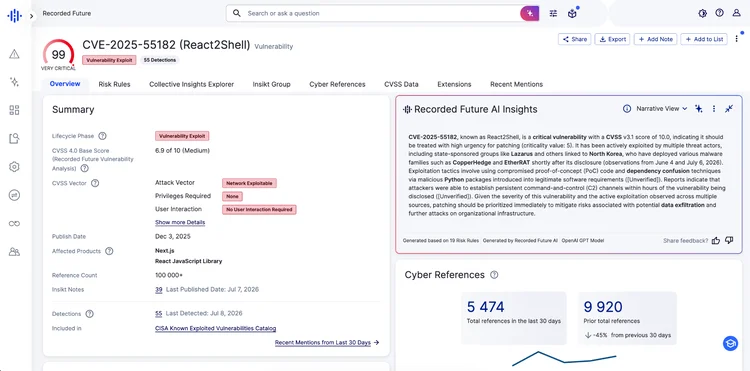
A detailed assessment of PoC trends associated with this month's vulnerabilities is accessible for Recorded Future customers, reinforcing the significance of vigilance and quick remediation in vulnerability management strategies. What this means for you, especially if you're working in this space, is that maintaining an active monitoring and quick response system can mean the difference between thwarting an attack and experiencing a breach.
Future Outlook and Implications
The findings from June 2026 aren't just numbers; they signal broader implications for the cybersecurity industry. As the sophistication of attacks continues to rise, organizations must prioritize not only patching existing vulnerabilities but also adopting a proactive approach to security. Waiting for a breach to occur often leads to reactive measures, which can be damaging in terms of reputation and financial loss.
Moreover, the continued rise in RCE vulnerabilities shows a troubling trend. If this behavior persists, we can expect attackers to refine their techniques, potentially leading to even more widespread and damaging exploits. This could necessitate a shift in how businesses allocate their cybersecurity resources, moving from a reactive to a more comprehensive, strategic posture.
Cybersecurity isn't just about defending against the latest threat; it’s about anticipating potential shifts. If organizations fail to address this surge meaningfully, they risk becoming prime targets for increasingly sophisticated cybercriminals. The stakes are getting higher—everyone should take note.



Discussion
Sign in to join the discussion.