Observable Framework simplifies dashboard creation by producing static, fast-loading sites without a heavy backend process.
For professionals accustomed to building dashboards with Shiny or Streamlit, the typical workflow involves relying on a server that executes Python or R logic on each user interaction. While powerful, this setup can slow performance, since the application depends heavily on its backend to deliver data dynamically. In scenarios where real-time interaction is vital, the server-centric model can introduce latency that frustrates users and hinders decision-making processes.
In contrast, the Observable Framework shifts this paradigm by processing your entire data pipeline during the build phase rather than at request time. The framework allows developers to create static HTML, JavaScript, and pre-processed data files that can be served directly through a browser, eliminating the need for continuous backend operations. This approach results in efficient dashboards that load like traditional static web pages, yet still offer dynamic interactivity—an appealing compromise for data-driven applications.
The complete source code for implementation is available at github.com/thierrymoudiki/tips-dashboard.
Core Features of Observable Framework
1. One-time Data Processing
Data loaders within the src/data/ directory execute at build time. Any script listed (be it .py, .R, .js, or .sh) produces static output files:
import sys, pandas as pd
df = pd.read_csv(SOURCE_URL)
df["tip_pct"] = (df["tip"] / df["total_bill"] * 100).round(2)
df.to_csv(sys.stdout, index=False)
Once the data is processed—potentially leveraging tools like Pandas or direct database queries—browsers retrieve the resultant files, thereby bypassing server-side execution. This pre-processing not only streamlines the data pipeline but also allows developers to debug issues before deployment, minimizing the surprises that can arise during real-time data processing in live applications.
2. Markdown Pages with Dynamic JavaScript
const tips = FileAttachment("data/tips.csv").csv({typed: true});
const filtered = tips.filter((d) => day.includes(d.day));
This setup ensures that JavaScript code blocks are inherently reactive. Notably, when an input changes, all dependent blocks automatically update, eliminating the need for additional event management or page reloads. This level of reactivity enhances user experience significantly—if you’re working in this space, you'll value the reduction in complexity that comes from a more straightforward interactivity model.
3. Input Management and State Generation
const dayInput = Inputs.checkbox(["Thur", "Fri", "Sat", "Sun"], {value: ["Thur", "Fri", "Sat", "Sun"]});
const day = Generators.input(dayInput);
This feature handles user input effectively, allowing for more sophisticated interactions without burdening the backend. Users can explore data dynamically, selecting options that alter visualizations or results with minimal load times—everyone wins here.
4. Declarative Chart Rendering with Observable Plot
Plot.plot({
marks: [
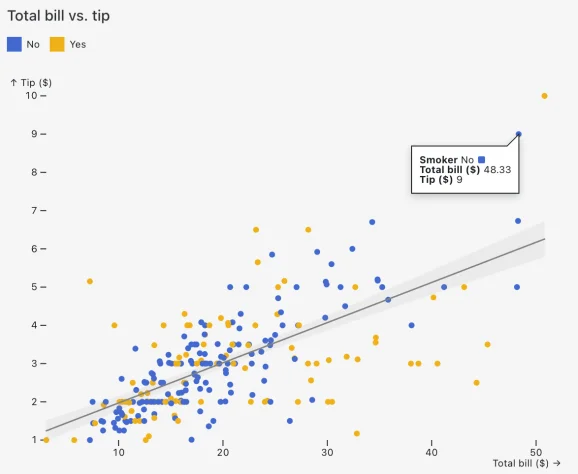
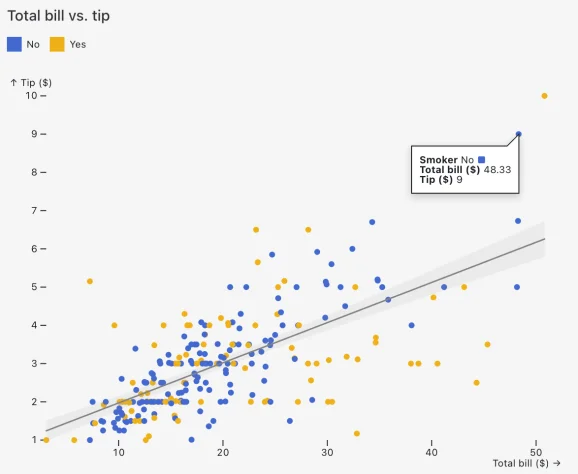
Plot.dot(filtered, {x: "total_bill", y: "tip", fill: "smoker", tip: true}),
Plot.linearRegressionY(filtered, {x: "total_bill", y: "tip"})
]
});
The framework employs a declarative style, allowing for clearer and more maintainable code. This is a significant improvement for teams looking to develop complex visualizations sans the headaches that often come with imperative drawing commands. The ability to focus on “what” you want to visualize rather than “how” to layout the visual elements simplifies the development process.
5. Efficient Deployment with Static Files
Running npm run build generates a static dist/ folder containing all necessary files. Loaders execute once and output is content-hashed to prevent cache issues, making deployment straightforward on platforms like GitHub Pages, Netlify, or S3. This simplicity means that developers can spend less time worrying about deployment intricacies and more on enhancing functionality or design.
Significance for Load Times
A conventional Shiny or Streamlit application requires various steps before it can display content, such as server initialization, session setup, and data loading—each impacting load times, especially for new user sessions. By contrast, Observable Framework performs these tasks during the build process. Users interact with static assets and a pre-processed data file; the JavaScript then activates the interactive elements, providing a user experience comparable to static websites. That's a big deal.
However, this approach entails a trade-off: without an active backend, live computations or per-user database queries won't be possible unless supported by additional server infrastructure. Still, for many use cases—especially involving tabular data manipulation and exploration—this framework offers a notably faster and less complex solution.
Getting Started
If you're interested in trialing the Observable Framework, a simplistic project like a restaurant-tips dashboard can serve as a practical example. Utilizing a Python data loader (via Pandas) along with reactive filters and visual elements, you can create a dynamic yet lightweight site with minimal coding—often under 100 lines. Post-deployment, there’s no server maintenance required, freeing developers to focus on functionality. This ease of use is a refreshing change for those who often find themselves bogged down by server dependencies and configurations.
The implementation details can be found at github.com/thierrymoudiki/tips-dashboard.
Future Outlook
The shift toward frameworks like Observable indicates a broader trend in web development where static generation can handle more sophisticated use cases. This movement could challenge conventional server-heavy architectures, particularly in environments where quick data interactions are essential. As developers increasingly seek more efficient workflows, the Observable Framework's emphasis on pre-processing and static serving might become a template for future dashboard implementations.
What's clear is that this framework provides a viable alternative for building data-centric applications with less complexity and reduced load times. Expect to see more adoption in settings where responsiveness is critical. What this means for you as a developer is greater flexibility without compromising performance. The potential for creating more interactive applications without the baggage of a full-fledged back end is significant.



Discussion
Sign in to join the discussion.