Recorded Future's new Automated Signature Creation enhances real-time threat detection, enabling faster responses to AI-generated vulnerabilities.

Recorded Future has launched a significant update to its Attack Surface Intelligence (ASI) platform with the introduction of Automated Signature Creation. This feature directly addresses the challenges posed by the rapidly evolving dynamics of AI-generated exploits, allowing organizations to fortify their defenses more effectively in an increasingly hostile digital environment.
At its core, ASI provides a continuous mapping of an organization’s external vulnerabilities, correlating emerging security threats with actionable intelligence. The latest addition enables the automatic creation of signatures—detection logics that empower the Recorded Future Platform to recognize specific vulnerable conditions across an enterprise’s assets in real time. This shift is not only about staying ahead; it's about survival in a landscape fraught with threats.
Responding to the Acceleration of Exploits
The pace at which vulnerabilities can be exploited has drastically increased, primarily due to advancements in AI technology. Recent models can autonomously uncover zero-day vulnerabilities across major operating systems and web applications—capabilities once reserved for elite cyber units. Between 2010 and 2020, Gartner noted that the time from vulnerability discovery to exploitation shrank from 45 days to just 15. In their latest report, Recorded Future observed this timeframe has since diminished to mere hours, emphasizing the urgent need for automatic responses over traditional defense methods. This is more significant than it looks. Organizations now face threats that can escalate faster than they can react, making time a critical factor in cybersecurity.
The Shift From Manual to Automated Processes
Historically, Recorded Future relied on expert-crafted signatures from its Insikt Group®, which, while reliable, operated at a slower pace. For example, last year, they developed a signature to identify vulnerabilities in the Trimble Cityworks platform involving CVE-2025-0994. This manual process, which allowed security teams to prioritize patching efforts by experimenting with a detection template, has become untenable given the surge in threat velocity. To put it bluntly, waiting for human input could be lethal.
Recent high-profile incidents, such as the exploitation of a zero-day vulnerability in Artifactory related to OpenAI’s systems, spotlight the critical need for speed in response mechanisms. These events underscore why organizations cannot afford to rely solely on manual processes anymore. The rationale for adopting Automated Signature Creation—capable of converting vulnerability data into actionable signatures in as little as 31 minutes—springs from such real-world pressures. This time efficiency means the volume of signatures generated within the platform can surge tenfold compared to previous manual methods, presenting a substantive advantage for those prioritizing security.
Functionality of Automated Signature Creation
To better understand how this new feature operates, consider the nature of a signature: it's a directive that queries assets for specific vulnerabilities. It takes the process from merely identifying assets to pinpointing those susceptible to breach. The Automated Signature Creation employs a three-step mechanism to enhance threat detection:
- The platform maintains an ongoing inventory of your organization's public-facing assets, including domain records and ownership data.
- Upon identifying a new vulnerability, it assesses the asset against current threat intelligence rather than relying solely on generic severity metrics, focusing on active exploitation scenarios.
- Once a vulnerability is recognized as pertinent, the Recorded Future Intelligence system autonomously generates a detection signature or product fingerprint in as little as 31 minutes.
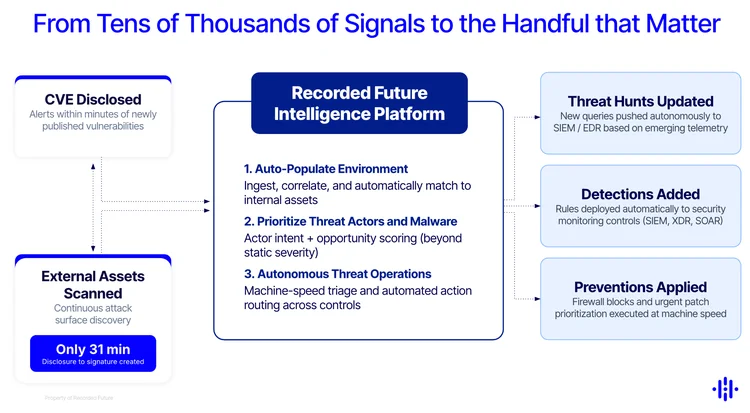
This rapid response capability positions Recorded Future as a leader in vulnerability management, equipping organizations to respond effectively to threats and minimize potential damage from exploitation. As the landscape of cybersecurity continues to evolve, tools like Automated Signature Creation will become indispensable in defense strategies. Understanding how to implement and optimize these tools can mean the difference between impenetrable security and catastrophic breach.
Implications and Future Outlook
The introduction of Automated Signature Creation is indicative of a broader trend in the cybersecurity sector that’s pushing for integration of AI in defensive measures. As threats increase in sophistication, relying solely on manual defenses isn't just outdated—it's a formula for disaster. What this means for you, if you're working in this space, is that a fundamental shift is occurring, one that involves a re-evaluation of how vulnerabilities are identified and addressed.
Organizations must consider not only adopting these technologies but also integrating them within their existing frameworks. This means investing in training and the support needed to fully utilize these advanced capabilities. And yet, there's an underlying caution; automation should not be seen as a silver bullet. Human oversight remains essential in interpreting data, context, and potential impacts. And if there's one thing the past few years have shown us, it’s that complacency can lead to vulnerabilities being exploited devastatingly.
Hence, as we look to the future, adaptability will be key. Organizations need to stay agile and responsive, not just to existing threats but to those unanticipated ones that could arise from an ever-complicating digital space. In such an environment, particularly where threats can morph within hours, the ability to automatically respond to vulnerabilities could mean the difference between securing information or facing ruin.



Discussion
Sign in to join the discussion.