Spatial machine learning requires focused evaluation and transparency to ensure reliable predictions across varied environments.
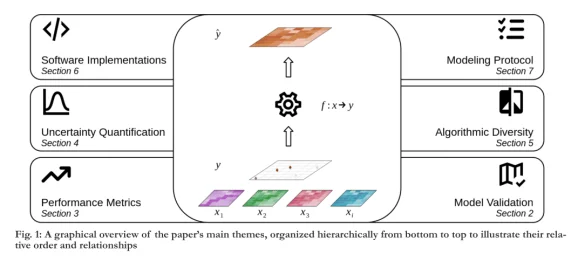
Spatial machine learning has cemented itself as a key technique for generating environmental and geographic prediction maps. While integrating field observations with remote sensing, climate data, and other predictor layers has grown simpler, the real challenge lies in assessing the reliability and transferability of the resultant models. This challenge isn't just academic; it has real-world ramifications, affecting how effectively we can predict things like climate impacts or habitat changes.
In a recent study titled Navigating challenges in spatial machine learning: validation, uncertainty, algorithms, and reproducibility, authors Jakub Nowosad and colleagues tackle this complexity by examining various interconnected factors. Published in Erdkunde, this work underscores that standard machine learning methodologies can't simply be repurposed for spatial contexts without adjustments. When researchers try to apply traditional methods to spatial data, they often find that the results don't hold up under scrutiny, raising questions about what practices should be adapted for dependable outcomes.
The authors emphasize that spatial dependencies, sampling biases, and varying landscape characteristics all influence how models need to be evaluated and understood. A model that shows high accuracy on generic datasets might still falter in real-world applicability where predictions are necessary. This disconnect highlights a recurring issue in machine learning: models often perform well on paper but struggle when faced with the messy intricacies of real-life environments.
Key Themes and Practical Insights
The paper delineates its discussion around six central themes:
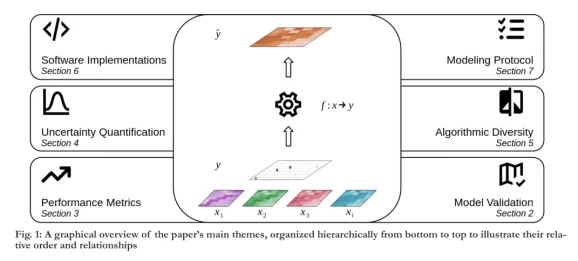
One of the foremost practical insights is that validation processes should align with the specific prediction scenario. Adopting prediction-domain adaptive evaluation methods can be crucial when simple random or spatial cross-validation fails to suffice. It’s essential to identify and communicate areas where training data diverge from the prediction domain, enhancing transparency and model trustworthiness. This isn't merely about statistics; it's about ensuring stakeholders can trust these models when making critical decisions based on them. If you're working in this space, understanding and communicating these nuances can dramatically impact project outcomes.
The Role of Software and Algorithmic Frameworks
While algorithmic enhancements are vital, they alone cannot tackle the breadth of challenges in this field. There’s a pressing need for benchmark datasets that feature diverse spatial properties, rigorous comparisons to baseline methods, and frameworks that effectively address uncertainty. Our understanding of algorithms tends to be superficial; it’s not just about choosing the right algorithm, but also about how well these algorithms can generalize to new conditions. In the R programming environment, several specialized tools cater to spatial machine learning workflows. Conversely, Python possesses an extensive machine learning ecosystem, albeit with fewer established spatial-specific functionalities.
In both realms, reproducibility heavily relies on meticulous documentation regarding data preparation, resampling strategies, predicted outcomes, software versions, and computational choices. Documentation might seem tedious, but it can be the difference between a reproducible study and one that’s easily critiqued or dismissed. Complex methodologies require complex explanations.
Advocating for Standardized Protocols
Crucially, the paper advocates for standard protocols in reporting spatial machine learning endeavors. Such frameworks would allow researchers to formally document their modeling objectives, spatial data characteristics, validation methodologies, uncertainty management strategies, and reproducibility resources. This initiative is tied to the ongoing development of the Spatio-Temporal Modelling Protocol (STeMP). As someone who follows tech protocols, standardization might seem like a boring detail, but these practices can improve the overall quality and credibility of research, benefiting the field at large.
In essence, the goal is to transition from performance-centric mapping to workflows that embrace spatial specificity, consider uncertainty, and emphasize reproducibility. While advancements in model accuracy are beneficial, enhancing evaluation processes, communication of uncertainties, software sophistication, and transparent reporting carry equal weight. How often do we overlook these foundational elements in the thrill of achieving high accuracy?
Future Outlook and Implications
As the discipline of spatial machine learning continues to grow, the implications of this work cannot be overstated. A more nuanced understanding of model reliability could open doors to new applications, from urban planning to conservation efforts. However, without addressing the foundational issues raised in the paper, we might see a proliferation of flashy models that fail in practice. The challenge will be balancing ambition with diligence, ensuring that as we make strides in algorithm development, we also establish rigorous standards for validation and reporting. Institutions, both academic and corporate, must take the initiative to adopt these standards. This isn’t just about improving existing practices; it’s about laying the groundwork for future innovation that can be trusted.
Footnotes
This paper draws from conversations held during the Advances in Spatial Machine Learning 2025 workshop. The authors thank the participants for their valuable insights!
 ︎
︎
Citation
@online{nowosad2026,
author = {Nowosad, Jakub},
title = {Navigating {Challenges} in {Spatial} {Machine} {Learning}},
date = {2026-09-08},
url = {https://jakubnowosad.com/posts/2026-09-08-erdkunde/},
langid = {en}
}
R-bloggers.com offers daily e-mail updates about R news and tutorials about learning R and many other topics.
Want to share your content on R-bloggers? click here if you have a blog, or here if you don't.



Discussion
Sign in to join the discussion.