Implementing systematic evaluations for AI agents reveals performance issues, enabling targeted improvements and clearer insights into decision-making failures.
Evaluating AI Agents: Beyond the Basics
One of the significant challenges faced when assessing
AI agents is the perplexing drop in performance post-update, leaving engineers scrambling for answers. When adjustments are made—whether it's tweaking the system prompts, modifying tool descriptions, or even upgrading the underlying model—the agent's behavior can shift dramatically. Without a systematic evaluation method in place, you quickly find yourself in a cycle of guesswork and repetitive manual tests.
That's where the power of
evaluations (evals) comes into play. By providing agents with specific tasks and measuring their performance against predefined criteria, evals create a repeatable framework for detecting inconsistencies. This structured approach moves beyond vague assumptions about an agent's efficacy to tangible, quantifiable outcomes. It enables teams to pinpoint exact failures, paving the way for targeted investigations and improvements.
Why Evals are Critical for Agents
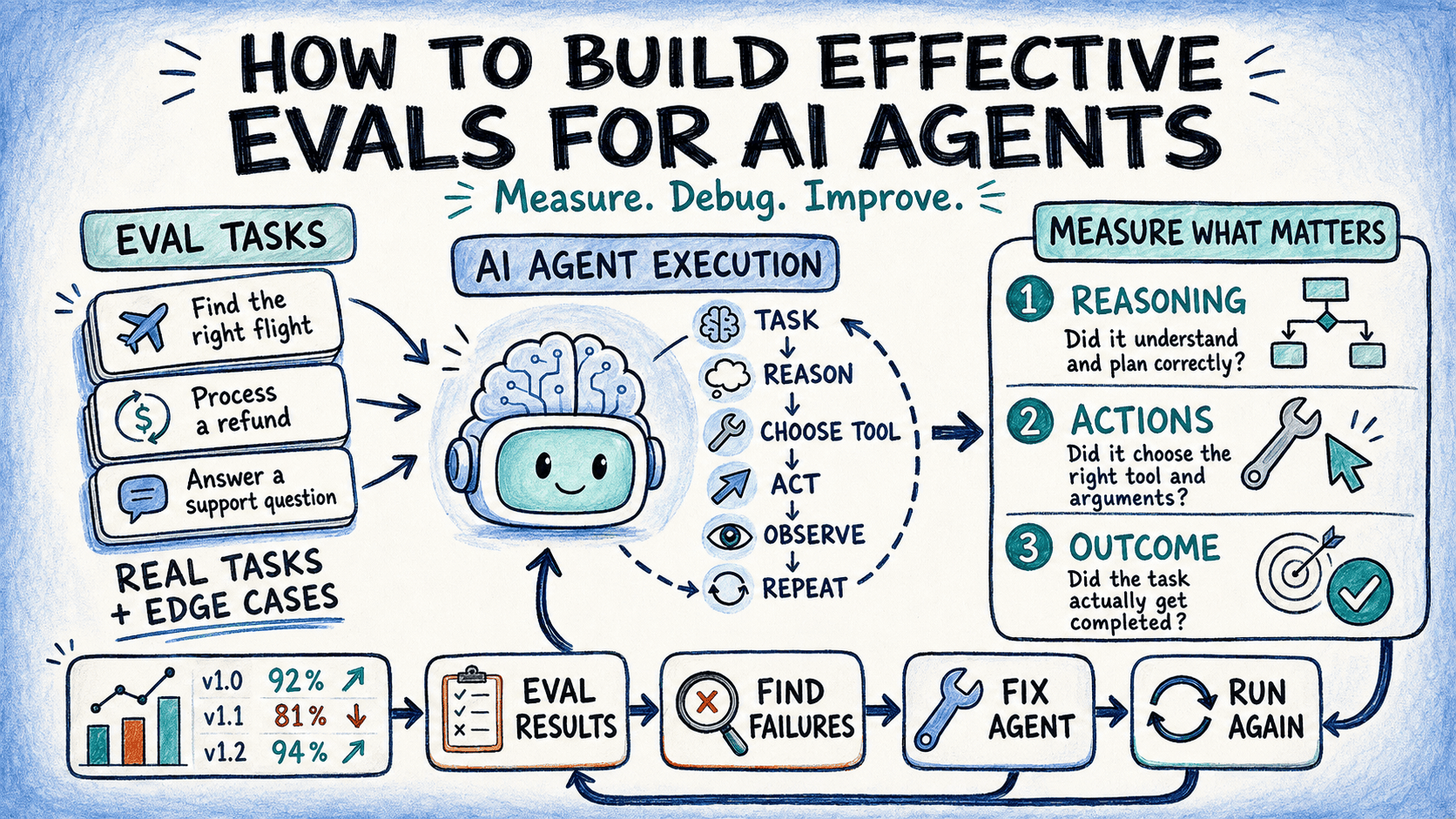
Traditional evaluations, characterized by a single prompt eliciting one response, aren't equipped to handle the complexity of agents. An agent’s process involves multi-step reasoning and decision-making that can diverge at each interaction. This means that a miscalculation early on can cascade, leading to compounding errors rather than isolated failures. Evaluators should thus think of agent failures not as singular events but dissect them into layers for a clearer understanding.
Specifically, defining errors across three categories—reasoning, action, and overall execution—can clarify where the agent faltered. For instance, think of a travel agent acting incorrectly: they could choose a flawed approach for booking, misuse a tool, or inefficiently complete the task. A well-constructed eval doesn’t merely signal that the task failed; it reveals the specific layer that led to the failure.
Crafting Your Initial Set of Task Evaluations
Starting your eval journey doesn't require extensive task libraries. A focused selection of well-defined tasks can uncover significant insights early on. Utilizing existing manual checks—common workflows, edge case scenarios, and routine pre-release tests—can streamline this creation process. Transforming these into repeatable evaluation tasks means you’re not reinventing the wheel with each assessment.
Ensure your task set strikes a balance. Incorporate situations where the agent is expected to perform well alongside those where it might stumble. In the case of a search eval, this would include queries that need search and those that can be resolved without utilizing the search feature. This ensures the evaluation not only checks for repetition of actions but also analyzes the agent's decision-making process.
Setting Clear Metrics for Evaluation Tasks
An effective eval task must consist of unambiguous success criteria that yield consistent interpretations from different reviewers. If a task is unclear or open to interpretation, you risk measuring how well a grader understands the task rather than how well the agent performs. Before finalizing any task, verify that all necessary information and context are present; if certain assumptions are required that aren't explicitly stated, you could misattribute an evaluation failure to the agent instead of the task design.
Providing a reference solution is a vital step; it acts as a benchmark for both task expectations and grader accuracy. If your agent consistently struggles, the first action should be to assess the task's solvability and ensure the grader understands acceptable outcomes. This simple precaution can dramatically improve evaluation accuracy.
Selecting Proper Graders
Not all components of an agent's behavior lend themselves to the same grading methods. The goal should be to
align the grading technique with the evaluation layer. Different behaviors require different approaches:
- **Tool selection and actions:** Opt for deterministic or code-based checks at the decision point.
- **Decision-making quality:** Evaluate the entire series of actions when the decision process matters.
- **Task completion:** Verify the final outcome with factual checks instead of depending solely on the agent's summary.
- **Open-ended outputs:** Consider a model-based grader when no fixed response exists.
- **Complex scenarios:** Rely on human reviewers where automated grading can miss nuanced judgments.
By default, evaluate outcomes rather than enforce an exact sequence unless the order is inherently vital to the task's success.
The Importance of a Reliable Testing Environment
The credibility of any eval hinges on the testing environment’s integrity. Trials must start from a clean slate: leftover data, cache, or shared history can skew outcomes, giving a false sense of performance. Favor partial credit systems over binary assessments when evaluating; recognizing where an agent excels can provide more insight than merely designating a pass or fail.
Consider
non-determinism when conducting evaluations. Because agents rarely produce identical results, a single trial could mislead. Measure two useful metrics:
- **pass@k**: This metric indicates the likelihood of at least one successful attempt among multiple tries.
- **pass^k**: Contrarily, this gauges the probability that all attempts succeed, much more critical for customer-facing contexts where reliability is paramount.
Your choice of metrics can significantly sway perceptions of an agent's reliability; without the right context, an unsteady agent might appear trustworthy, and vice versa.
Final Thoughts on Implementing Evals
Incorporating evals into your development cycle transforms the approach to AI agent performance assessment from subjective impressions into measurable engineering principles. By leveraging repeatable tasks and clear grading standards, insights into improvements, regressions, and underlying reasons become much clearer.
Start small, ensure alignment with actual user demands, and focus on concrete outcomes rather than rigid workflows. Good evals will dissect reasoning, tool usage, and task completion, while maintaining an isolated environment for reliable results. A continuous feedback loop is essential—test, measure, diagnose, and enhance—making AI agents progressively more dependable and responsive to real-world needs.



Discussion
Sign in to join the discussion.